
Point Five — The Tramp
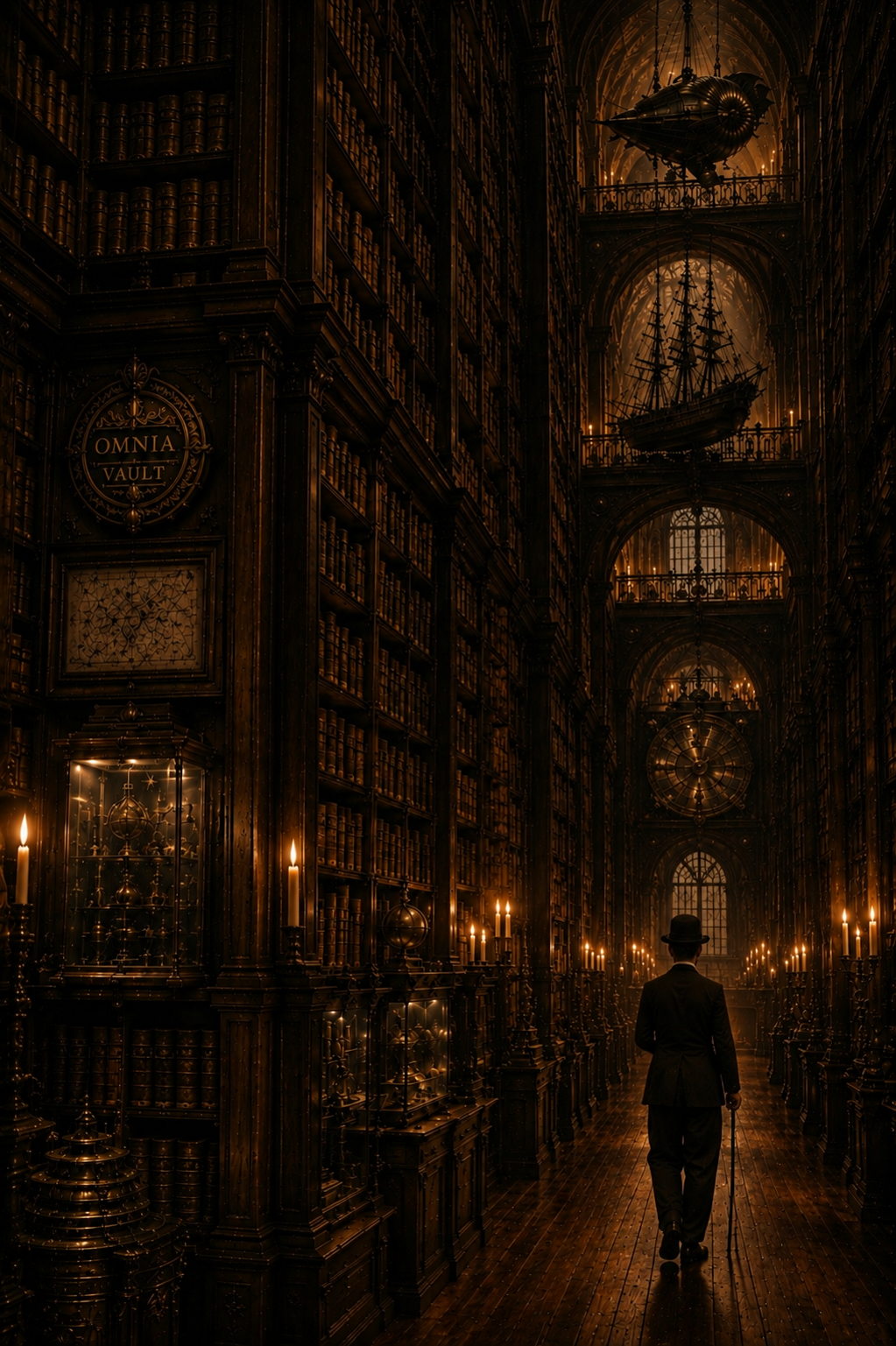
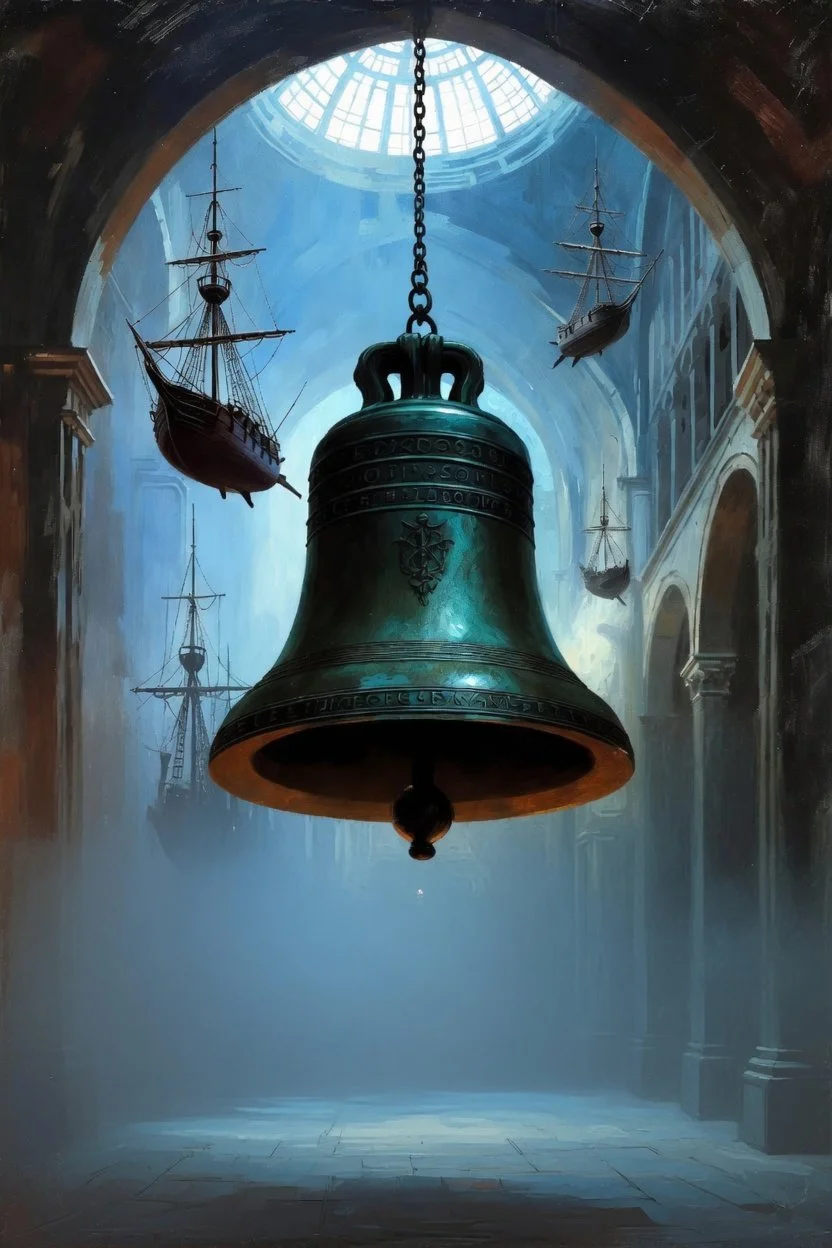
As every house has its own particular noises, so does the vault. We have bells like Emmanuel swinging on its ropes. We have real size ships hanging from the celestial roof. The hearths are always lit, and we have a raven croaking nevermore from time to time. As you can imagine, silence is never complete.
Until one day… everything went quiet.
Félicette looked up at Nevermore. But he didn’t say a word.
Chacha lifted her head and looked dumbfounded. Not a sound was emitted, from anywhere!
The door to the Shadow Hearth opened and a small figure appeared. He wore a bowler hat, a tight jacket, baggy trousers and oversized shoes, a bamboo cane, and a small toothbrush mustache.
The clothes were worn with use but clean. He moved his mustache from side to side and started walking bowlegged, swirling the cane. When he got to the carpet he tripped and fell forward making a somersault, jumping up and with another twirl he landed on his feet. He made sure his coat was straight. And continued walking his strange walk towards the library.
We all looked but no one made a sound.
He paused at what seemed to be his destination, somewhere in the middle of the corridor, among a long row of spines he studied with great care. He continued his strange walk down the corridor. And suddenly he stopped.
Something we hadn’t seen before happened. The spine of one of the books started to glow slightly.
The Tramp stopped and turned his head back a little. Then he turned all the way while jumping in place and twisting and when he landed he smiled!
He went to the wooden ladder that are all over the vault and are movable, to gather books that are too far up. But it wouldn’t budge. Eventually he started going up. He tripped and we all thought he was going to fall, but at the very end he had regained his equilibrium. Since the ladder was on the opposite side of the library, he went to the very top, and to everyone’s astonishment he kicked back with his heel and the ladder moved first to the middle of the corridor, where he started moving his arms and his cane to maintain his balance. Finally, and with some acceleration, the ladder ended up moving — with quite some speed, I may add — to the desired side of the library. Thinking about it now (because at the time we were all very much perplexed by what we were witnessing) we don’t think he calculated his every move very well. But he always landed on the right side of them. Curious.
When the ladder landed it still didn’t make a sound. But even Chacha lifted her head to see what was happening.
The character landed on top of the library with a pirouette. He then walked on top of it until he got to the place where the book glowed. We could read the title as he took it out with the utmost respect. It was called Footlights. He sat then and there, feet hanging from the top of the library as he read it. When he finished we could make out a tear moving down his left cheek. But he was smiling. He hugged the book for a few seconds, like it was a baby, and then he put it back on the shelf.
He made his way back to the ladder. This time he just slid down, like a fireman!
He walked with a more brisk step now, towards the door of the Shadow Hearth. Before leaving, he turned around, made a bow, taking his hat off, almost dusting the floor with it. He turned around again, made a little side jump and clicked his heels, and left.
Suddenly the vault returned to its normal self, all sounds at once. And the book on the shelf, Footlights, went back to sleep.
Every behaviour has its origins.

Item I-1: Excalibur
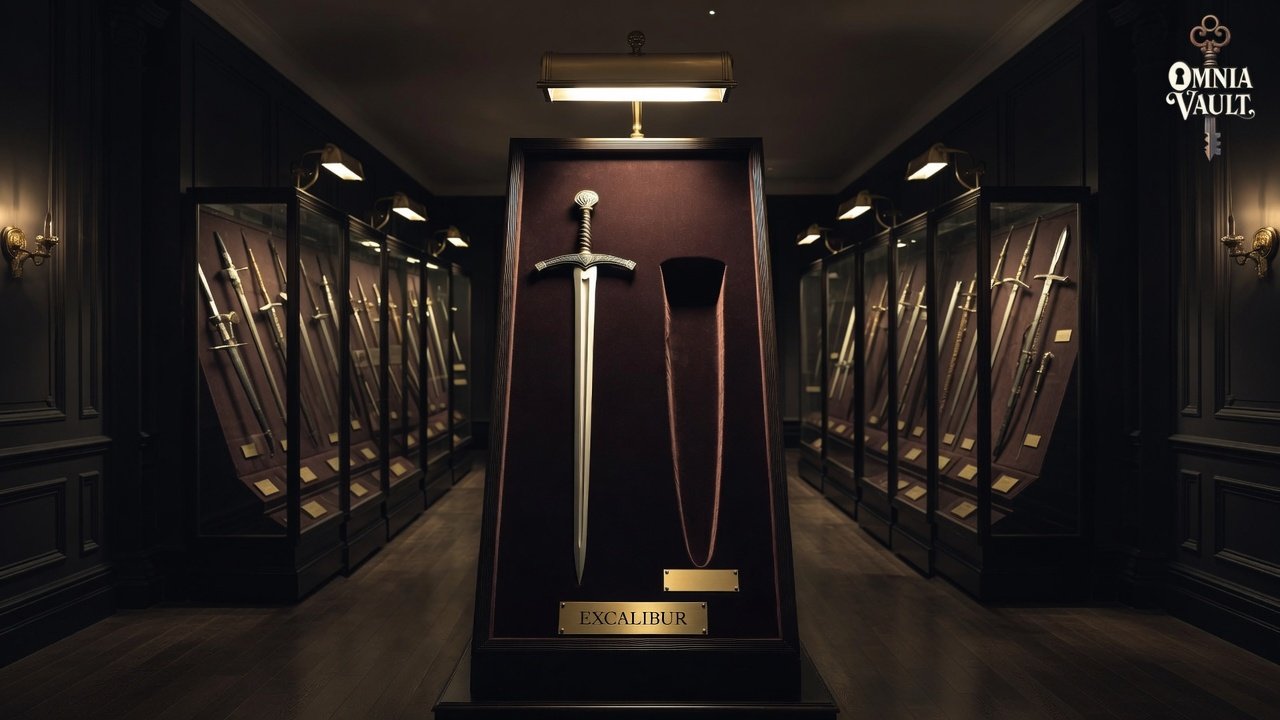
Greetings dear reader! I'm Doctor M, welcome to the Omnia Vault. The first drops of rain could be heard splashing the window. The storm kept pelting the vault for the second week in a row, luring everything into a gloomy grey. Thankfully, all the hearths are lit and it is warm and comfortable close to Chacha. Nevermore had taken up residence on the back of the reading chair, and Félicette, as is her habit, had gone somewhere higher up and more philosophical. Today I'm going to tell you about a new object we received this week. Master S was a little out of sorts during this event, he doesn't like incomplete registrations into the vault. I am really excited at the prospect of having the second part of this item, and the owner to come see them. For now, let me tell you exactly how the day went.
I opened the door to the Shadow Hearth and walked through with a tray in my hands — tea and biscuits, ready to be served. I left the tray on the table by the fireplace, walked around Chacha to stand beside Master S at the window. The weather was stormy, with lightning on the horizon and thunder sounding a few seconds later. Master S doesn't like this weather. He never told me why, now that I think of it. It's almost like he is… afraid of it? In any case, there was a story coming.
-Greetings, S! I said.
-Good afternoon, Doctor.
-Would you care for some tea? I brought biscuits. I said, smiling. I know they are your favourite.
-They are indeed. Indeed.
-What's on your mind, S? I asked.
-Mmm? Yes, yes. Biscuits.
-I waited until he came around to it. I served the tea. Added a cloud of milk to mine, and lemon to his, and sat back and waited.
After a couple of minutes a white blur ran through the hearth, turned the corner and kept running. Master S looked startled by the sound, and then smiled, which I found strange.
-Ah, yes, yes. Tea. And biscuits! My favourites, he said.
-I smiled.
-I heard we had a new arrival, S. Want to tell me about it?
-He sighed.
-We have a new arrival, yes.
-Another pause.
-It's the sword, M. He said it like I should know what he was talking about. There are hundreds of historical swords, S. You are going to have to be more specific, I said.
-He only said one word, and a chill ran down my spine.
-Excalibur.
-Of course, I know several versions of the story—but only after an item arrives do we begin searching for its true provenance. So, I asked him: Care to tell me about it?
He cleared his throat.
The lore of the sword has been mistaken for many years.
The sound of thunder made the windows tremble, and rain started pelting them. At that precise moment Emmanuel, as always, rang on F sharp from the Celestial Gallery. It took a few minutes for the bell to stop ringing, although the sound remained.
The legend says Arthur took Excalibur from the stone. There is even a film about it! Anyway, that was his first sword — the one that made him King — and it was called Clarent. A simple but beautifully crafted blade—one that, if not for Excalibur, would likely have been a legend in its own right.
It was the sword that made Arthur King of Britain. It was a ceremonial sword. A peace sword… but we'll come to that later. Excalibur was given to him by the Lady of the Lake.
-"Mh-hmm," I murmured. I knew that much.
We need to introduce a bit of Arthurian legend that is mixed with the actual history, he continued. As you might know, Arthur had a half-sister called Morgan le Fay — also called Morgana. She was a benevolent healer early on, but turned into Arthur's worst enemy as they grew older. Why? Difficult to say. But she is one of the most prominent characters in that story. Now, here is the important part. Arthur was thought to be invincible because of Excalibur, but at one point, when Morgana gives her lover Sir Accolon the real Excalibur, she hands Arthur a fake, hoping Accolon will kill Arthur with his own sword. Arthur's blade breaks mid-fight before he realises what's happened — he continues fighting with a broken sword and still manages to defeat and kill Accolon. So that proves the sword was not the magical item.
-Do you know what made Arthur unable to bleed from a wound? Besides him being a master swordsman, that is.
-"It was the scabbard," I said.
Master S looked at me dumbfounded for a few seconds.
-How did you know? He asked, perplexed.
-Oh. I just guessed, S. It was a lie, of course. I know that part of the story. I am an Arthurian enthusiast after all. But I didn't tell him that.
Of course, of course, he continued. In any case, you are correct. The scabbard is — was — the magical item. When Arthur was given Excalibur, Merlin told him that it was a magnificent sword, but that the magic lay in the scabbard. With it, he would be able to suffer certain wounds, but not bleed from them.
He picked a biscuit from the tray, stood up and started walking. I followed, trying to keep up with his pace. He continued. The most famous sword in the world and we have it incomplete — such a shame! We went to the stairs and as always I stopped by the paintings. Dorian was there, beautiful as ever. I always stop in front of that one. I'm not entirely sure why. Perhaps it's because inside the vault, one wonders whether the portrait is still doing its work.
We arrived at the Workshop where a glass case surrounded a velvet cushion holding a magnificent medieval sword. The golden hilt was simple and etched with a design of two serpents. Excalibur's blade was overwhelmingly bright — so much so that I was blind for a few seconds. It is a weapon capable of cutting iron as easily as wood.
I mentioned this to Master S. I can't imagine being on a battlefield and seeing Arthur unsheathe Excalibur with that light!
Yes, he said. I usually have it covered when I'm not here, so as not to disturb the other occupants. But you are indeed right. He was a force to be reckoned with. And the sword is a big part of why that was.
What happened to him eventually? I asked. There are so many versions of the story, I said, a little sadly.
Well, let me continue from where we left it, he said. Morgana took the sword and the scabbard. After Sir Accolon was killed, and bearing magic herself, she realised the scabbard was the item that made Arthur almost invincible. After the treachery, Arthur sent his knights to capture Morgana and retrieve the scabbard. She escaped with a few of her followers. Being about to be captured, she threw the scabbard into a lake with no name, and she transformed herself and her knights into stones so they could disguise themselves. The trick worked — Arthur's knights rode along the trail and never found them. But the scabbard was lost, and it remains so.
And this is what you are so concerned about, S? I asked.
Indeed, he said. We are still looking for it.
But S, items appear at the vault unannounced. Excalibur is here. I'm pretty sure the scabbard will join us soon enough.
-I hope you are right, Doctor. I hope you are right.
-What happened to Arthur? I asked.
The ultimate betrayal, he said. While Arthur went to France to fight Lancelot, Mordred — his own son — seized the throne of Britain,
declared himself king, and attempted to force Guinevere to marry him. Eventually they faced each other, and while Arthur delivered
a deadly blow, Mordred, brandishing Clarent, dealt a fatal wound to Arthur at the Battle of Camlann.
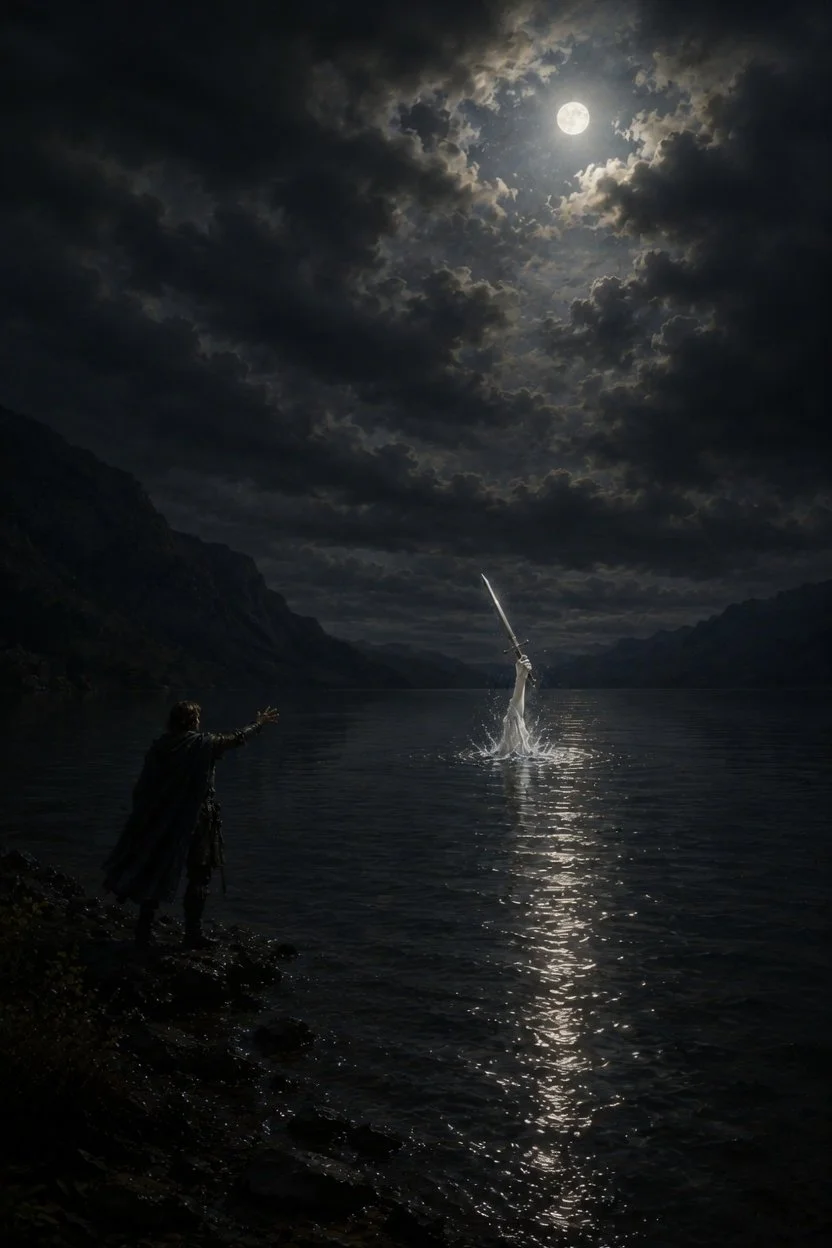
While he lay dying later that day, Arthur asked one of his most trusted knights, Sir Bedivere, to go to the lake and throw the sword in.
Bedivere later said that when he did so, a hand appeared from the lake and took the sword mid-air. It brandished it three times and
disappeared beneath the water.
-And Arthur? I said.
Here is the part no one but the participants truly understand, said Master S. He was collected at the war camp by Morgana.
He asked to be escorted only by her, on a bed made of branches and tapestry. They rode out and were never seen again.
We know they went to Avalon, but we haven't been able to contact either of them since.
And Emmanuel rang again — but softly this time, as if he already knew. By then the storm had passed, and Master S looked carefully
out the window to make sure. One day we are going to solve that mystery.
So, the story of one of the greatest kings in history is full of love, hate, betrayal, blood, magic, and swords. But the secret was always
in the scabbard.
Excalibur is now part of the vault, and we do hope that when the scabbard decides to join us, Arthur will also come to see
them both displayed.
-We would like that very much.
-What is hidden is not invisible.
— ✦ —
Item I-1: Excalibur rests in Active Stasis, Level II — The Workshop, under a covered glass case on the central table. The hilt is gold, etched with two serpents. The blade, when uncovered, produces a light with no obvious source. Master S has noted his objection to the incomplete registration in the official record. The scabbard is still in the lake. The thread on the cork board is red.
— Dr. M, writing from the Shadow Hearth, 105 Palimpsest Road
The Whistler
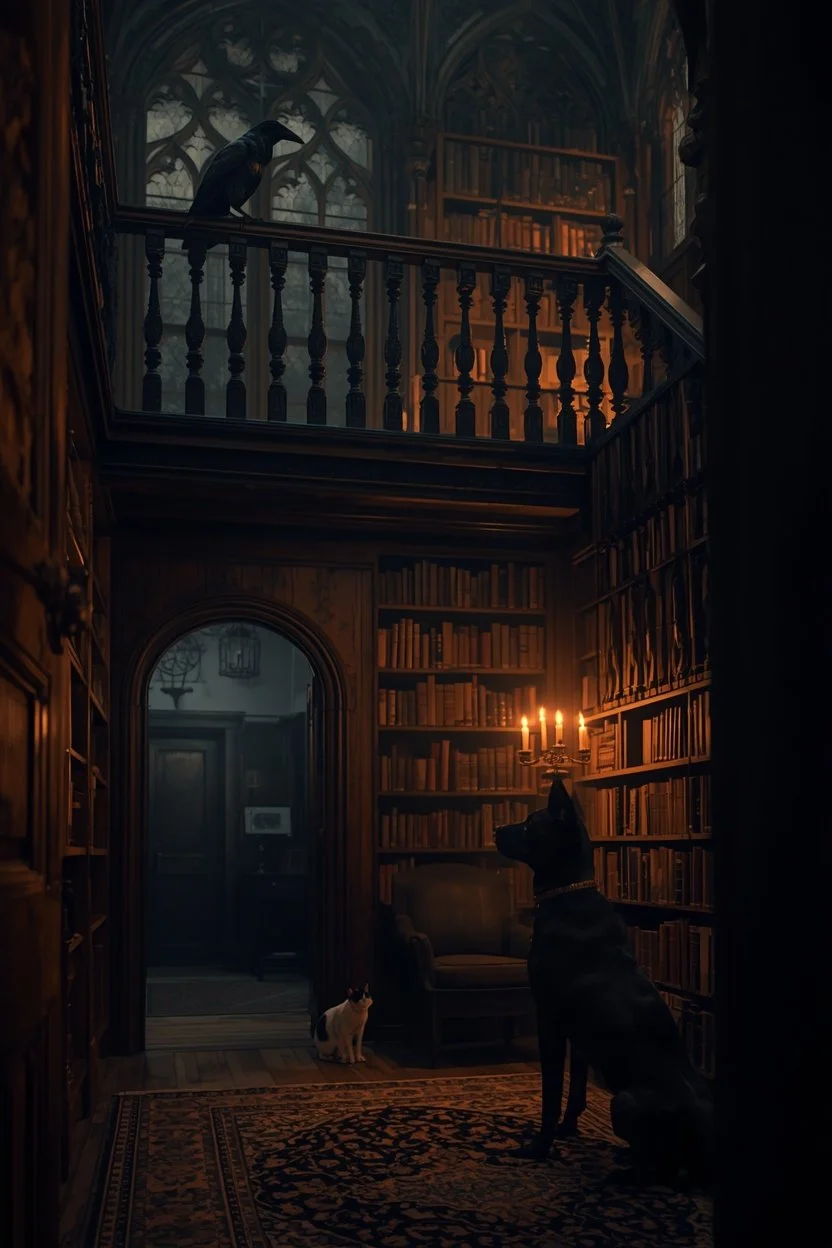
Nevermore turned his head down from his perch on the Nautilus. Félicette stopped licking herself and turned toward the door. Chacha lifted one ear. The whistling grew louder as the door from the Shadow Hearth opened, and the gentleman who walked in looked like he owned the place.
He stopped by Chacha and left something near her that took only one smell before the dog ate it whole. Nevermore says it was bacon.
More than walking, he seemed to glide around the room, looking at some artifacts, moving others — the kind of thing that, had Master S seen it, would have given him an apoplexy. But he put them all back, contrary to what you might expect, considering his profession.
He took one look at the chess table and kept moving, lighting a cigarette as he went. Also not allowed at the Vault. But to Master Lupin, such trivialities as rules do not apply.
He looked up and saw Félicette watching him from the Workshop balcony, and he winked at her. She flushed. We all saw it.
As the cigarette came close to its end, still whistling, he returned to the chessboard. He folded his gloves properly, set the cigarette on the crystal ashtray, and looked at Sherlock’s position. He stood there for a whole minute, and we all stopped breathing for that exact amount of time.
Then he made his move. No overthinking. No excess force. What one would call a resolute move. And then it was like the whole Vault had been restraining itself from making a noise, and suddenly it could breathe again. Something like a smirk crossed his face. The Vault has seen that expression before. It never leads anywhere good for the other side of the board. He was a gentleman, after all.
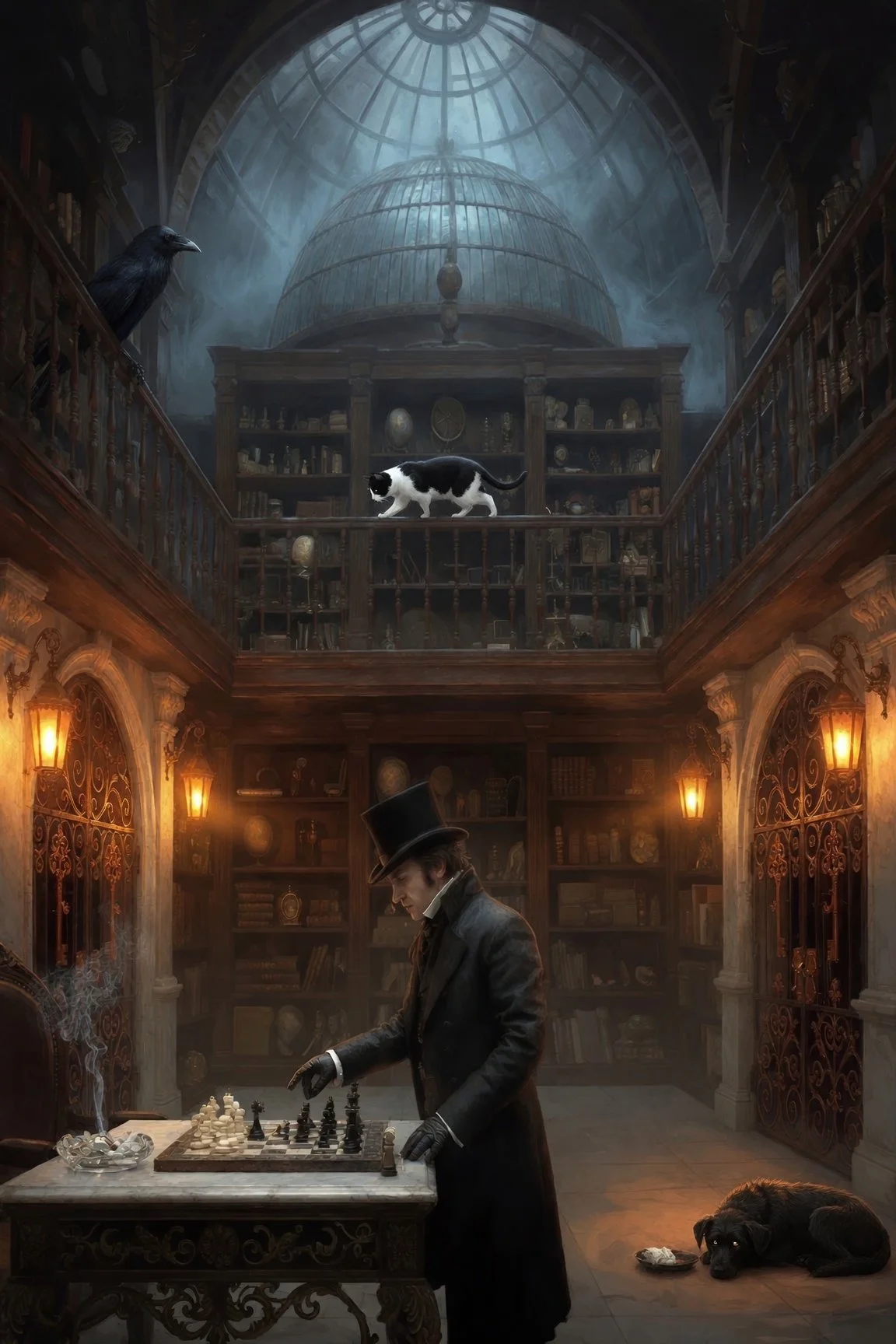
He turned, hands behind his back, and walked to the door. He stopped underneath Félicette and threw what looked like a piece of cheese up, which she caught with her mouth. Nevermore said “Nevermore,” and he tapped the rim of his high hat in salute to the raven. Chacha opened one eye and closed it again. Then he left.
The Vault was once again alone with the sounds of itself.
Every behaviour has its origins.
The Flask and the Mold
Filed under: Science — The Shadow Hearth Library
I was walking Dr. Watson through the library corridor when Idéfix came through.
I say came through — what I mean is that he entered at considerable speed from the direction of the staircase, apparently in pursuit of something only he could see, skidded on the Persian runner, corrected, and made for the corner toward the Hearth.
"Idéfix!" I stopped, arms folded, in the posture of someone who is not really angry but would like it understood that she could be. "Master S told you not to run in the Vault! And so did I!"
Idéfix did not slow down. He disappeared around the corner without breaking stride or offering any explanation.
Watson had stopped too. He looked at the space where the dog had been, and then at me, with the expression of a man waiting for the part where it makes sense.
"He's Gaul," I said, and shrugged.
After a moment, he followed me down the corridor. This is, I find, the correct response to most things at 105 Palimpsest Road.
But I should go back a little, because the afternoon did not begin in the corridor. It began by the fire.
Watson had arrived earlier in Holmes's wake — Holmes having appeared without announcement, as he tends to, to resume his position at the chess table with the focused displeasure of a man who has been thinking about a problem for several days and has arrived at a conclusion he finds personally offensive. He had looked at the board for a long moment, sat down, and said nothing. Lupin's last move was still there, white gloves folded with their usual precision beside the ashtray, cigarette still faintly smoldering. Holmes had not touched a piece. He was simply staring.
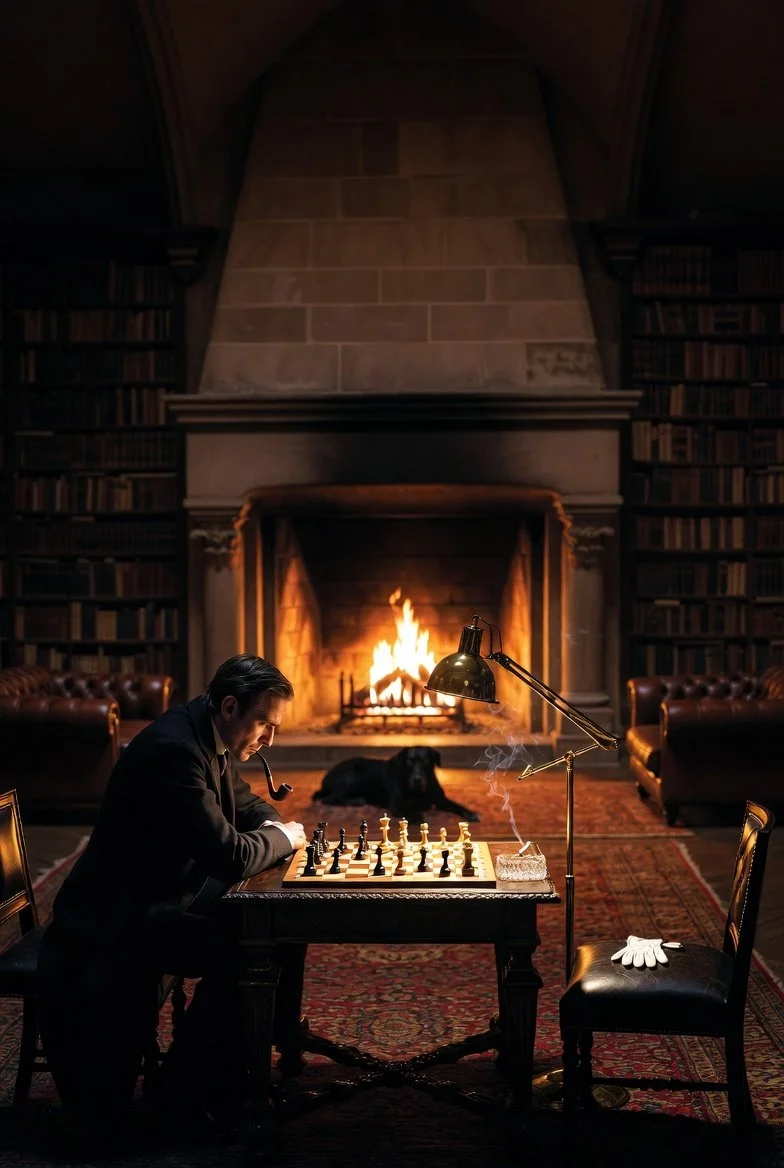
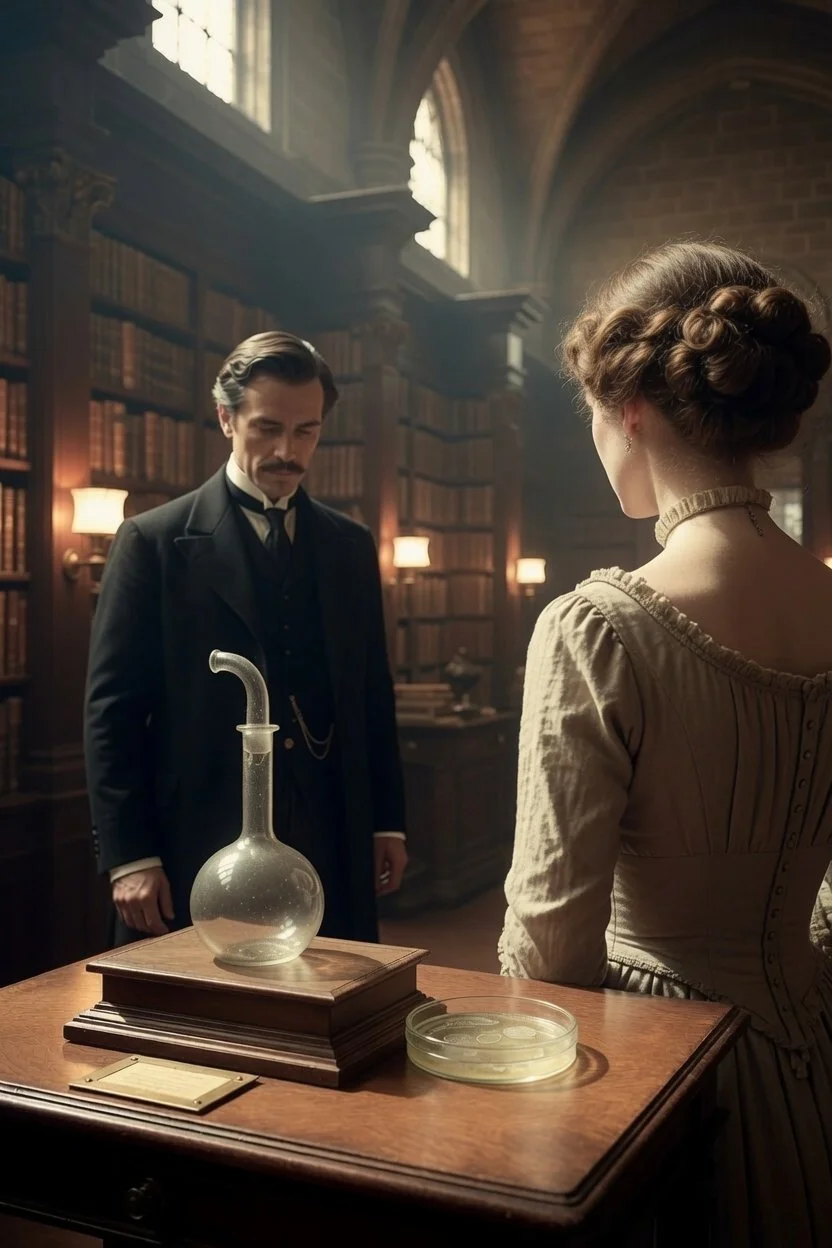
Watson and I had settled into the conversation that tends to fill the time during a chess session — which is to say, I was talking and Watson was being good company, while Holmes conducted his silent war with the board a few feet away. We had got as far as the weather in Sussex when Holmes, without warning, addressed the empty chair across the table.
"What are you playing at, you little rascal!"
There was, of course, no one in the chair. Only the move Lupin had left behind, which was apparently the source of the offense.
"Mr. Holmes," I said. "Please don't raise your voice here in the library. And we don't permit insults among our guests, as you well know. Is that clear?"
Holmes mumbled something. I did not ask him to repeat it. I have learned that there are apologies one waits for and apologies one will not receive in this lifetime, and that recognizing the difference early saves a great deal of time.
"He does apologize," Watson said to me, quietly. "For what it's worth."
"I know he does, Dr. Watson," I said. "You do it very well on his behalf."
Watson watched the board for another moment with the candid resignation of a man who has watched this particular drama many times. Then he turned to me.
"I had thought Master S might be about," he said. "I wanted to ask him whether he'd ever settled the matter of the Honjo blade."
"He's in the Workshop," I said. "Something arrived this morning. He has that particular look he gets — the one that means he won't be down for dinner and may not be entirely sure what day it is by Thursday. I haven't asked what it is. He'll tell me when he's ready, and not a moment sooner."
Watson nodded, with the resigned fondness of a man who has waited on another man's methods for most of his life.
"Perhaps," he said, "you might show me something in the meantime."
I was delighted to oblige.
I led him to the library corridor that runs the full length of the Shadow Hearth's eastern wall. I always find myself immersed in this corridor. Its high Gothic-vaulted ceiling, the floor to ceiling bookshelves, the smell of old books. Perfection in my opinion. I told Master S to leave Items and Objects here, and they are catalogued but not confined to cases. Master S finds this professionally irregular and has noted in the official record. I find it gives the corridor a living quality, as though the objects are simply resting between one chapter and the next, which is, in a sense, precisely what they are doing.
We had passed Darwin's magnifying glass and were perhaps twenty feet further along when Watson slowed.
In a shallow alcove between the shelves, on a small oak stand at roughly eye height, sat a glass flask. Sealed. Perhaps thirty centimetres tall, long-necked, the glass darkened slightly with age. Inside, if you looked carefully, was a faint residue along the lower curve — something dried and dark that had once been something else entirely. Beside it, on a brass placard, the item number. And beside that, under a small bell jar, a sealed petri dish, its surface clouded with the particular grey-green of a very old and very significant mold.
Watson looked at both for a moment. Then at me.
"The flask," I said, "belonged to Louis Pasteur. The dish belonged to Alexander Fleming. They are not related to each other, except in the way that one impossible thing sometimes clears a path for the next."
Watson's expression shifted in the way that a physician does when a subject intersects with his actual knowledge rather than his general curiosity. He looked back at the flask.
"Pasteur," he said. "The rabies work."
"The rabies work," I agreed. "July 1885. A nine-year-old boy named Joseph Meister arrived at Pasteur's laboratory in Paris. He had been bitten fourteen times by a rabid dog. His mother had heard there was a chemist in the city who had been vaccinating dogs against rabies, and she had put her son on a train, because the alternative was watching him die and she was not prepared to do that."
Watson said nothing, which is, in my experience, how physicians listen when something is serious.
"Pasteur was not a physician," I continued. "He held no medical license, which created a rather delicate situation given what he was about to do. He had tested the vaccine on dogs and on rabbits with considerable success but he had never given it to a human being. His own colleagues argued against it. The vaccine was new, the data sparse, and the boy was nine years old." I paused. "He gave it anyway. Thirteen injections over ten days, each one a slightly more concentrated preparation than the last. He had Dr. Grancher administer them, because Grancher had the license and Pasteur did not. Pasteur stood in the room."
"And the boy survived," Watson said.
"And the boy indeed survived. He never developed rabies. He became, as far as anyone can determine, the first human being to be successfully vaccinated against it." I looked at the flask. "Pasteur kept quiet about it initially. The first vaccination was conducted in something close to secrecy. It was only when a second case arrived, a shepherd boy named Jean-Baptiste Jupille who had been bitten defending younger children from a rabid dog, that Pasteur went public. Jupille also survived. Pasteur presented both cases to the French Academy of Sciences in March 1886 and caused, as one might imagine, something of a sensation."
"I remember," Watson said quietly. "It was in the papers."
Of course it was. He was there for it, in the way that you are there for the things that happen during the years of your life, present for the headline without knowing what it will come to mean.
"What most people don't know," I said, "is that the controversy was immediate. A physician named Michel Peter presented eleven cases of patients who had died after Pasteur's treatment. He called them deaths by intentional inoculation, laboratory rabies, he said. He presented this to the Academy of Medicine in Paris. He was not a crank. He was a serious man making a serious argument, and for a time it was not clear who was right."
Watson frowned. "And?"
"And the vaccine worked. Not perfectly, not without risk, but on balance, measurably, undeniably. Pasteur had been correct. The Institut Pasteur was founded in 1888 and Joseph Meister, the nine-year-old from Alsace, eventually came to work there as a gatekeeper. He spent his adult life at the place that had saved him."
I stopped.
Watson waited, because he is a man who understands when someone is pausing before something difficult.
"He died in 1940," I said. "German soldiers came to the Institut and demanded access to Pasteur's crypt. Meister was the caretaker. He refused to let them in." I did not explain what German soldiers in Paris in 1940 meant, because Watson had no frame for that year and no way of building one in a corridor on a Tuesday afternoon. "He died that day."
The corridor was quiet. Somewhere above us, faint and unhurried, came the sound of Nevermore shifting on his perch.
Watson looked at the flask for a long moment. Then he said, simply: "The boy the vaccine saved."
"Yes," I said.
We stood there for a moment longer than was strictly necessary, which I think was the right amount of time.
Then I gestured toward the petri dish under the bell jar.
"That," I said, "is Fleming's. September 1928. He had left a petri dish of staphylococcus bacteria on his laboratory bench before going on holiday and left it uncovered, which was either carelessness or destiny depending on your disposition. When he came back, a mold had grown on the dish. In the area around the mold, the bacteria were dead. Not inhibited. Dead. The mold had produced something that killed them."
Watson leaned closer to the bell jar, his physician's instinct apparently overriding the minor obstacle of the glass between him and the specimen.
"He called the substance penicillin," I continued, "after the mold, Penicillium notatum. He published his results in a paper in 1929. The scientific community received it with not much enthusiasm at all. Fleming himself was not entirely sure what he had. He thought it might be useful as a topical antiseptic, something to apply to the surface of wounds. He did not fully grasp that it could work inside the body, carried through the blood, reaching infections that no surgeon's knife could follow."
I paused.
"It took two men at Oxford, Howard Florey and Ernst Chain, 10 years to work that out. They are the ones who turned Fleming's laboratory curiosity into a drug that could be given to a dying patient and bring them back. Fleming got the Nobel Prize in 1945. So did Florey and Chain. There were years of arguing at the Nobel committee about whether Fleming deserved it alone or not."
Watson straightened. He looked at the dish under its bell jar with an expression I found difficult to read, something between admiration and the particular melancholy of a physician who understands exactly how many people died of infections between 1885 and 1945 and cannot quite stop counting.
From the Shadow Hearth, twenty feet away and around the corner, came the faint sound of a chess piece being set down. Not moved. Set down, with the precise, controlled force of a man who has finally decided something.
I glanced toward the doorway.
Watson glanced too.
"He recognised the flask," Watson said. It was not a question.
"Almost certainly," I said.
"And the dish?"
I said nothing. Watson looked at me, and I think he understood, because he is not a man who needs everything explained.
He had retired to Sussex by then, to his bees and his quieter life, and the world had moved on into a century he had not been built for. Fleming's mold was 1928. The antibiotic was 1941. The Nobel was awarded in 1945. All of it belonged to a time past the edge of what Holmes knew, and he knew that it did, and had said nothing.
Watson turned back to the flask and the dish. He looked at them together for a moment,— the two objects in their alcove, the residue in the long-necked glass, the clouded grey-green surface of the dish.
"One impossible thing," he said, almost to himself, "clearing a path for the next."
I smiled. "I thought you'd see it that way."
We walked back toward the Shadow Hearth. Holmes was at the board, looking at a position he did not like, in a game he was losing to a man he could not see. He did not look up as we came in.
Watson went to his chair by the fire. He sat down. He looked at Holmes's back for a moment with the candid assessment of a man who is not currently being observed.
"He'll find it," Watson said quietly, not to me particularly. "He always does. It simply takes him longer when the other man won't sit still."

On the rug, Chacha had not moved. Beside her, curled into the curve of her side and entirely asleep, was Idéfix exhausted, I can only assume, by whatever it was he had been chasing, which he had evidently not caught and would not remember by morning. Chacha had one eye open. She did not appear to mind.
I picked up my notebook, and sat down to write you all of this.
What is hidden is not invisible.
Item: Pasteur's Flask remains in the Shadow Hearth Library, eastern alcove, catalogued under Science — Medicine. Fleming's petri dish rests beside it under a bell jar. Master S has noted his objection to both being shelved without cases in the official record. The cigarette on Lupin's side of the board is still burning. Idéfix is still asleep.
— Dr. M, writing from the Shadow Hearth, 105 Palimpsest Road
Napoleon at the Vault:
The Bicorne and the Sword
Filed under: Headwear — The Workshop
Greetings my dear readers. We had a visitor today, and I had to wait a certain amount of time before telling you about it, because it left me pondering things I did know, and others I didn’t know I knew. I will tell you everything that happened and you can do your own pondering.
I was at my desk when he arrived.
I say arrived — what I mean is that he appeared, in the way that certain historical figures appear, as if the concept of knocking had simply never applied to them and it would be embarrassing for everyone involved to suggest otherwise. The door of the Shadow Hearth opened, and there he was: five foot six in his boots, the grey coat, the hands already clasped behind his back, the eyes doing that thing they do in all the portraits — assessing, calculating, finding the room wanting.
Chacha opened one eye. Closed it again. This was, I felt, the correct response.
“I received,” he said, surveying the Shadow Hearth with the expression of a man who had surveyed considerably larger rooms, “a letter.”
“You did,” I said. “We sent it.”
“The letter informed me zat certain objects belonging to ze Emperor Napoleon Bonaparte ’ave been catalogued at zis — establishment.”
“That is correct.”
“I am ze Emperor Napoleon Bonaparte.”
He looked at the chair as if it had said something offensive. Then he said “I will want to speak to the man in charge. I want to see my belongings.” I was expecting this reaction, so I didn’t feel offended by the comment. I have dealt with Genghis Khan before, after all.
I calmly replied “Monsieur Bonaparte” — I left the Emperor out, since by now he had been removed of that title a long time ago. “I am Dr. M. I am the person in charge, and you are my guest. I will ask you again, please have a seat so we can chat before we show you where your items will be kept.” And showing him the leather chair with my hand, I repeated: “Please.”
He took five seconds of scrutiny towards me, but I didn’t flinch. I even showed him a small smile.
He finally sat down, back straight, hands on his knees, a soldier through the end.
Now, Readers — I should tell you something about Napoleon Bonaparte before we go any further, because there is a version of him that history has handed us and a version of him that arrived at the Shadow Hearth on a Tuesday, and they are not entirely the same man.
The version history gives us is the silhouette. The bicorne worn sideways — always sideways. The grey coat. The hand tucked in the waistcoat. The height, which has been argued about for two centuries and which I will not be adjudicating here, because Master S has already noted in the official record that he finds the debate undignified and I am inclined to agree.
The version that sat in my leather chair was something slightly different. Still imperious — that doesn’t leave a man, it simply relocates — but there was something underneath it. Six years on a rock in the South Atlantic does something to a person. He had spent those years dictating his memoirs to anyone who would listen, shaping his legend with the focused attention of a man who knows posterity is the only audience that matters now. The result was a portrait of a visionary betrayed by lesser men, by fate, by weather, by generals who failed him at the crucial moment. All but himself. It was very well written. It was not entirely honest.
But we will get to that.
Master S appeared in the doorway of the Shadow Hearth, looked at our guest, looked at me, and went back upstairs without a word. This was not rudeness. This was Master S establishing the terms of the visit before our guest could establish different ones. I have always admired his efficiency.
“I will want to see ze objects,” said Napoleon.
“I thought we might have a conversation first,” I said.
He looked at me as if this were a new concept being introduced into his world. Then, after a moment: “Very well, madame. What do you want to talk about?”
“Tell me about the bicorne, s’il vous plaît,” I said. I think he appreciated me asking in French.
He coughed. And then — in the manner of a man who has spent six years perfecting his own account of everything — he told me about the number sixty.
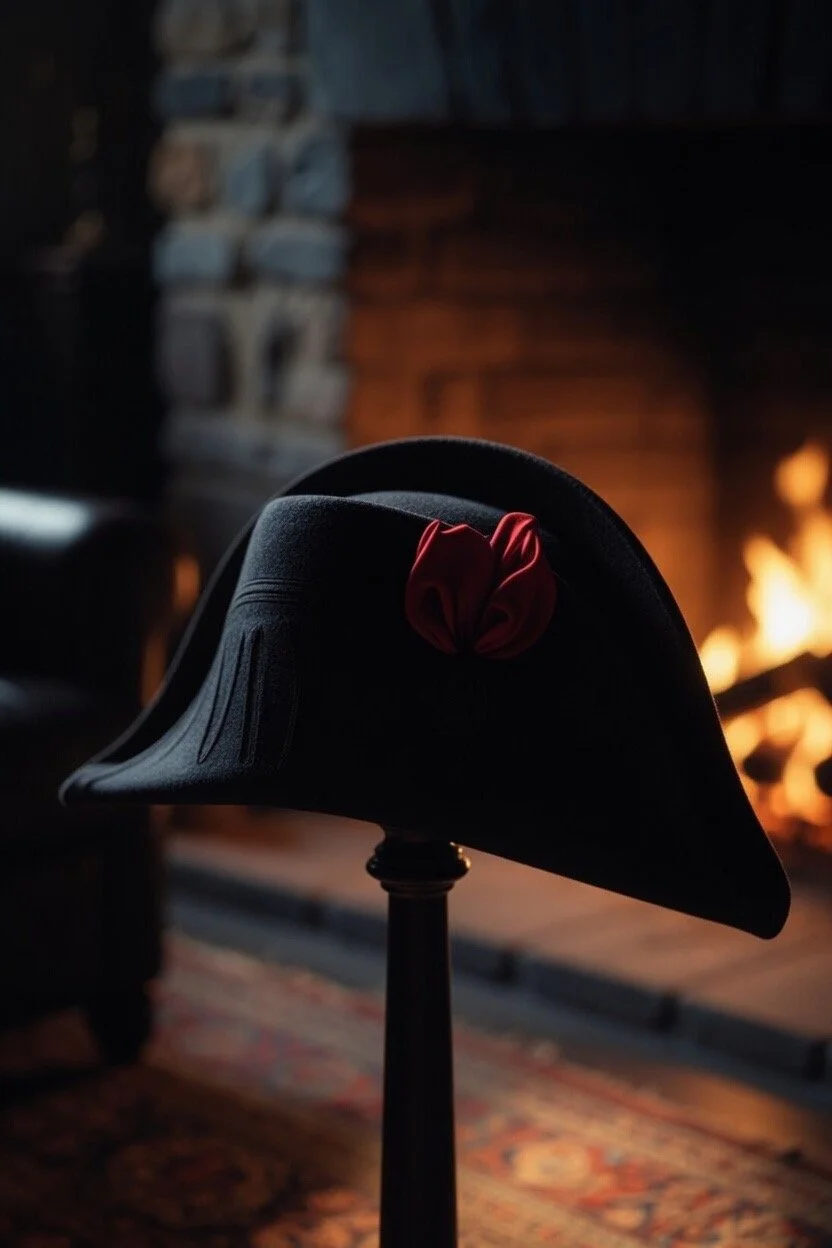
“That is, roughly, how many bicornes I ordered over the course of my career. I had them made by Poupard — my official hatter. The cost would have bought a small fleet, but you will find the expenditure defensible given the strategic function.
“The strategic function was this: I wore my bicorne sideways. Every other officer of the era wore theirs front to back — the en colonne style. I wore mine en bataille, which meant the wings of the hat pointed toward my shoulders rather than my face. From a distance, on a battlefield, through smoke and chaos, this made me instantly recognisable. My soldiers could find me with their eyes from a quarter of a mile away. The silhouette was the strategy.
“I also had the leather sweatband removed from every hat I owned. I could not bear the sensation. Poupard learned this early and simply stopped including it.”
Of the sixty bicornes, fifteen to twenty have been fully authenticated and traced. Most are in French museums. One was placed in his coffin. He took four with him to St Helena — which tells you something about what he thought he might need on a small island in the South Atlantic, or perhaps about what he could not bring himself to leave behind.
The Vault’s bicorne arrived with his other belongings, in a case that bore no label. Master S opened the case, noted the dimensions, confirmed the absence of a sweatband, and filed it under Item III-4. He has not elaborated on the filing.
“My sword?” Napoleon asked, after a few minutes of silence.
“Master S is cataloguing it now,” I said. “He will be finished when he is finished.”
Napoleon opened his mouth. Closed it. This, I felt, was significant progress.
I invited him to go upstairs. I think he was disappointed no fanfare was thrown for his presence. A cat walked by, birds flew in the Celestial Gallery, nobody stopped for him. I think he may have been more surprised than annoyed or angry.
The Workshop received our guest with its usual indifference — the brass lamps casting their tight amber pools over the tables, the cork board above Master S’s desk doing whatever the cork board does that I prefer not to examine too closely, the specimens in their cases emitting their faint blue light from the eastern wing. Felicette was on the central table, which is against the rules, reading over Master S’s shoulder, which is also against the rules. Neither of them acknowledged us.
The sword was on the examination table. It was magnificent — the gold hilt, the blade that had crossed rivers and changed maps, the weight of it that you could sense even from across the room. Napoleon saw it immediately. His entire bearing shifted, the way water finds its level.
He reached for it.
Master S placed one hand flat on the table between Napoleon and the sword without looking up from his journal.
The room was very quiet for a moment.
“It is not yet catalogued,” said Master S, to his journal.
Napoleon withdrew his hand. He clasped it behind his back again.
I began asking my questions.
On the Iberian campaign — the invasion of Spain — he was evasive for two full circuits of the Workshop balcony. The third time I asked, he stopped walking.
“It was,” he said, looking out over the balcony railing at the Shadow Hearth below, “an error of — of calculation. Ze Spanish — zey did not behave as populations ’ad behaved before. Zey did not — accept.” He paused. “I underestimated what a people will do when zey are insulted in their own ’ome.”
I wrote that down. He noticed me writing it down. He did not ask me to stop.
On Russia, I asked once. He changed the subject with the practiced fluency of a man who had been changing that subject for six years. I noted that he had changed it, and we moved on. There are questions a man will answer on a Tuesday in the South Atlantic that he will not answer in front of a journal, and I am aware of the difference.
On Waterloo, he was quiet for a long moment. Then: “Incompréhensible,” he said. Just that word. He had said it before — to someone, somewhere, on a June anniversary he had not wanted to acknowledge. “Incompréhensible day.”
“Fate,” I suggested, gently.
“Fate,” he agreed. And then, almost too quietly to catch: “And Grouchy. And my own cavalry, ’alf an hour too soon.” He paused. “But mostly Fate.”
I let him have that.
We went up to the Celestial Gallery on the way back.
I did not plan this. I simply walked in that direction, and he followed, and then we were standing in the cold light of Level III with the suspended fleet above us and the
navigational instruments on every table and the maps — the great maps — spread across the long surfaces of the Cartography Annex.
He stopped.
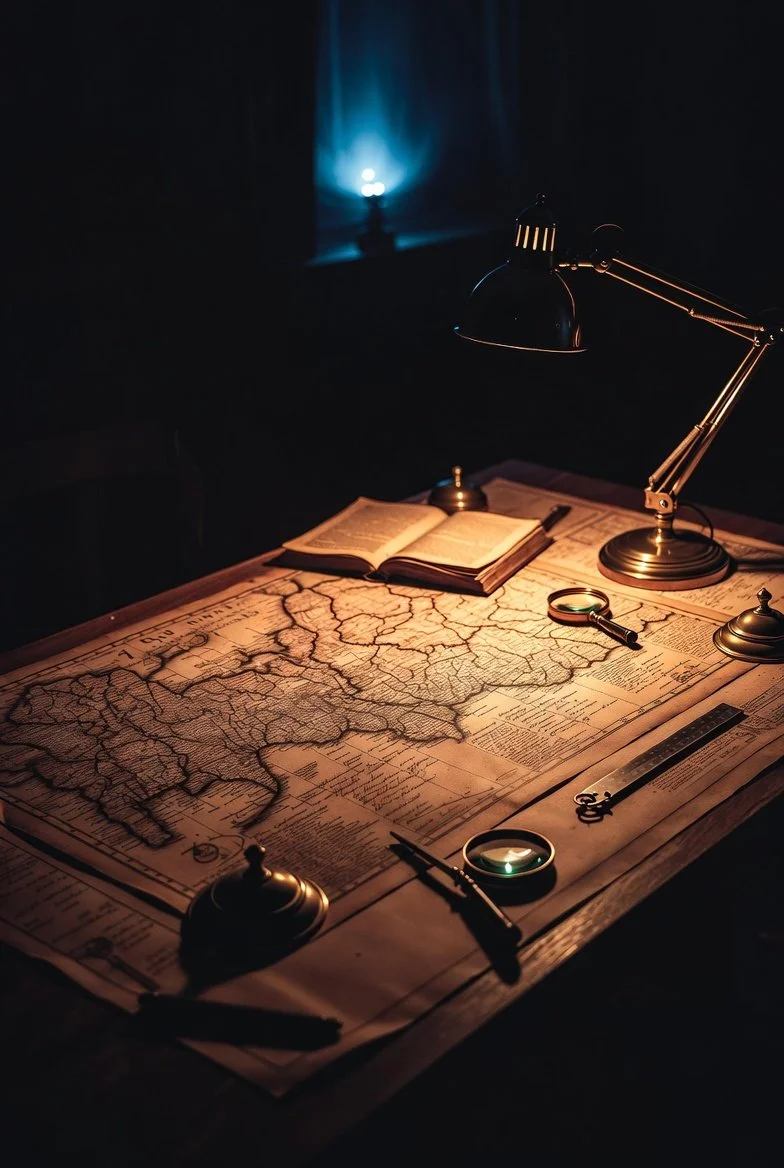
On the central table, unfurled and weighted at the corners with brass instruments, were Alexander’s campaign maps. Persia. Bactria. The route to India. The edges of the world as it was known in 323 BCE, annotated in a hand that has never been definitively identified, the routes marked in a faded red that might once have been brighter.
Napoleon leaned over the table. He did not touch. He simply read — the routes, the distances, the scale of the ambition — with the eyes of a man who had spent thirty years thinking about exactly these questions.
His posture changed completely. For a moment he was not Napoleon-from-St-Helena. He was the other one.
Then he straightened up, clasped his hands behind his back, and said quietly, to the map rather than to me: “He went farther than I did.”
Just that. In French.
Master S, who had followed at a careful distance, was examining a celestial globe on the far side of the room with great concentration.
I said nothing. There was nothing to add.
We went back downstairs.
In the Shadow Hearth, Napoleon stopped at the chess table. He looked at Holmes’s side, at Lupin’s side, at the white gloves folded with their particular precision, at the crystal ashtray
with its smoldering cigarette.
“Who is playing black?” he said.
“A gentleman thief. His name is Arsène. He is also French,” I said.
“And white?”
“An English detective,” I replied.
Napoleon considered this. He seemed to find it amusing. “Mon ami Arsène is winning,” he said, and kept walking.
Then he crossed to where Item III-4 was resting, and he picked up the bicorne. He turned it over once in his hands. He looked at the interior — at the silk lining, at the absence of the sweatband, at whatever it is a man sees when he holds something that was with him in the last years of everything. He put it back. He set it straight on its stand with a precision that was not quite nostalgia and not quite grief and was, I think, simply the habit of a man who always knew where his hat was.
He put on his coat. He moved toward the door.
From somewhere in the upper shadow of the room, Nevermore said: “Nevermore.”
Napoleon stopped walking for exactly one second.
Then he opened the door and stepped out into the corridor that leads back to 105 Palimpsest Road.
Chacha had gone back to sleep.
Lupin’s cigarette was still burning.
What is hidden is not invisible.
Item III-4: Napoleon’s Bicorne remains in the Headwear Collection, Level II, Workshop. The silk lining retains its original perspiration stains, which the item’s previous owner declined to comment on.
Master S has noted his objection to items being handled without gloves in the official record. The sword is still being catalogued. Napoleon did not ask when it would be finished.
— Dr. M, writing from the Shadow Hearth, 105 Palimpsest Road
Comedy Was the Dangerous One
Filed under: Books — The Workshop
Dr. M came into the Shadow Hearth with her usual smile — the smile of someone who enjoys her work. She was humming a very old, rowdy sailor’s song, which I suspect she doesn’t know the lyrics to. Master S does, though, and he smiled. She was carrying a pile of books in both hands when she suddenly stopped. From the corner of her eye, she could see the hat rack. The bowler hat and the swan-handled cane were unmistakable. Mister Alex DeLarge was in the Vault.
As if sensing something was wrong, Master S appeared in front of her.
This has happened before. The presence of Alex brings a strange atmosphere to the Vault — to the whole castle, in fact. And Dr. M seems the most affected by it, for reasons she has never fully explained.
Master S saw the look on her face, and his voice softened in the way it only ever does for her.
“Has he broken any rules?” she asked.
“Not yet. No.”
“What is he doing?”
“Talking to Maestro Beethoven on the Celestial floor. Or trying to. I don’t think old Ludwig can hear him.”
That brought the smile back to Dr. M, and she patted Master S on the forearm.
“Don’t worry. I have Nevermore and the Cheshire Cat keeping an eye on him. And Beethoven too. He tends to wander where he is not allowed.”
“Come. I have something to show you.” And he led her upstairs to the Workshop.
The painting on the first landing made her stop. It always did. The attic, the sombre light, the Gothic-Victorian furniture, the Creole figure in a nightgown. Bertha. Poor Bertha. She continued up the stairs, but a little sadder than before.
Now, Readers — there is an arrangement at the Vault that the Doctor can only enter the Workshop if Master S is present and allows it. It does happen, particularly when a new object or discovery arrives or is archived. From the trembling in Master S’s chevron mustache, you could tell something big was brewing.
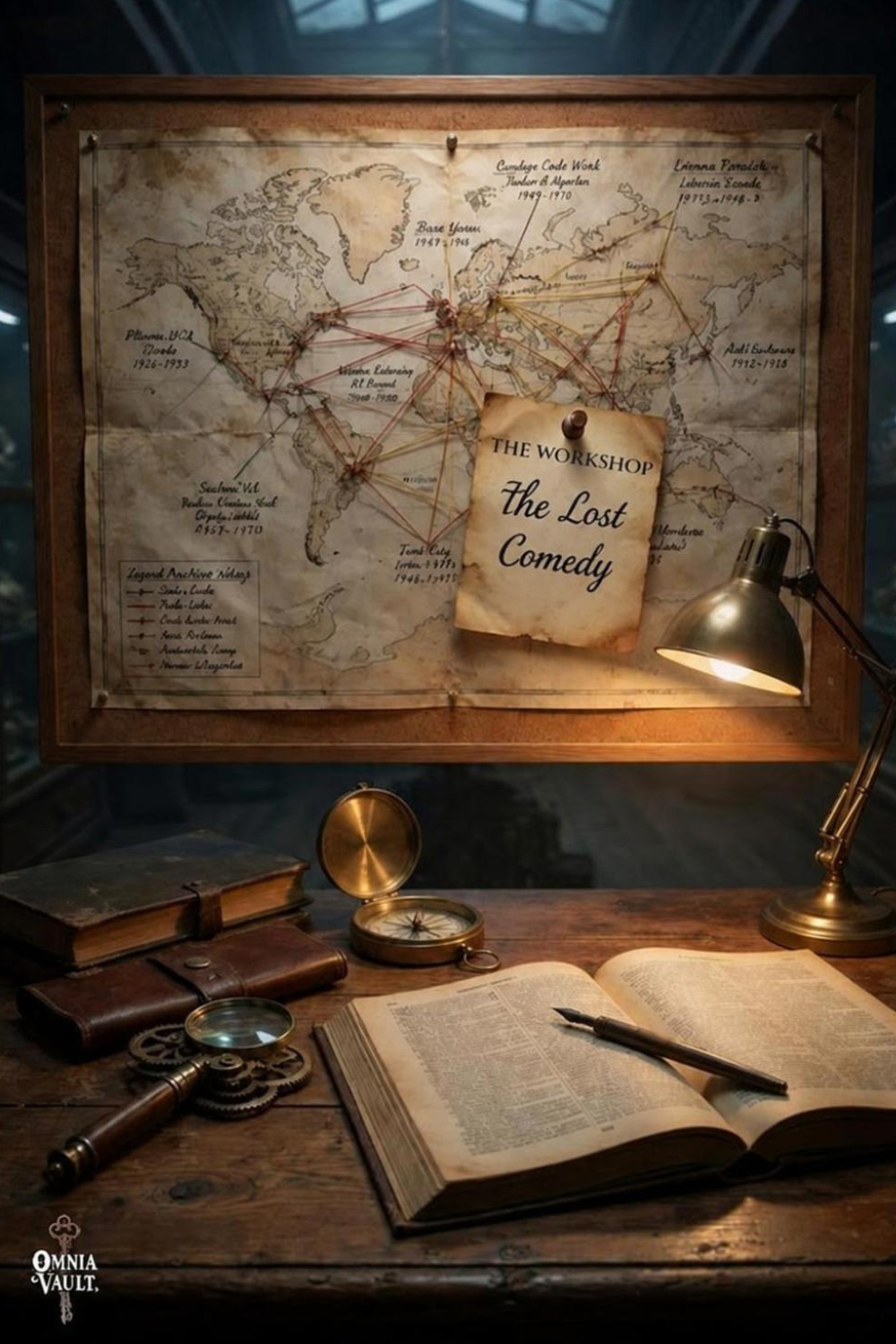
The Workshop is not your usual workshop. It is Master S’s thinking made physical — every object in its exact position, every lamp at its precise angle, every open journal marking exactly the page he left it on. The working tables run all around the balcony, each one dedicated to a specific item currently under examination. The walls are lined with cabinets, Wunderkammern, fishbowls small and large — very large, but that is for another day. This is his domain entirely, and it feels like it.
“As Felicette has been telling you,” Master S continued, looking sideways at her to see her reaction, “I have been inquiring again about Tome II.”
And react she did. First she turned red as a beet, then she started getting agitated, and finally she blurted — “We have not been —”
“It’s all right,” said Master S. “I don’t mind the little cat reading over my shoulder. She is quite remarkable, I must say.”
Of course, they are talking about Felicette — the first cat to be sent into space and return alive, by the French. She went up in 1963 and came back safely, and history promptly forgot her. Everyone thinks Laika was the only one but they are wrong.
“So what’s the news? I thought you were at a dead end.”
“I was. But I recently received news from the Herculaneum updates through back channels, and there may be a new avenue of research. Let me tell you the story first, as this object has not been archived yet.
“When Aristotle wrote the Poetics, it was divided into two books. Book I was on tragedy — which we know even today as the foundation document of literary theory in the Western tradition. The vocabulary it gave us for discussing drama has lasted two thousand four hundred years. Without it, there is no Shakespeare, no Racine, no modern dramaturgy as we understand it.
“Are you following me so far?”
“Yes, Master S. I think I’m following you through the explanation of one of the most famous books in history. But thank you for checking in on me.”
“Ahem. Well, then. What you may not know is that there was supposed to be a Book II, called Comedy.”
“Yes, I know that too. The Name of the Rose by Umberto Eco was about that — but everyone knows that’s storytelling.”
“Aha. But that is where everyone is mistaken!” Master S exclaimed. “The novel is fiction. The premise — that someone, somewhere, deliberately suppressed the text rather than letting it survive, whether for religious reasons or another — is a theory that genuinely circulates among classicists, even if most of them will not admit it at dinner parties. The book existed. And furthermore — I believe it still does.”
“Well, Master S, I haven’t seen you this excited about a project since researching and finding Moby Dick’s bones!”
“Ahh yes. She was an elusive one. But nothing like this one, Doctor. Nothing like this one.
“See — even Aristotle refers to it himself. Cross-references in later Greek and Roman commentary confirm it was a real text, read and discussed. And then, at some point between late antiquity and the medieval period, it disappeared.
“Nobody knows when or how. There is no record of its destruction, no surviving copy, no fragment longer than a few lines of disputed paraphrase. It simply stopped being copied — and in a manuscript culture, a text that stops being copied for two or three generations effectively ceases to exist. And here is the shame of it. Because of multiple factors — including a certain Roman emperor — roughly two-thirds of Aristotle’s work has disappeared. Comedy may simply be one more casualty among many.
“Or that is the official story.” A small spark appeared in his eyes. “I told you nobody knows when or how. But there are some of us who can speculate why.”
From somewhere far above, faint and half-heard, the opening notes of Beethoven’s Ninth drifted down through the floors of the Vault. Neither of them mentioned it.
“Let us recap what we have found so far. First, the Tractatus Coislinianus. A Greek manuscript from the tenth century, catalogued as Coislin 120. Buried inside it is a short, anonymous Byzantine text — located at the Bibliothèque nationale de France in Paris — a summary of a theory of comedy that maps almost perfectly onto the structure of Poetics Book I, but for comedy instead of tragedy. Many scholars believe this text could be the lecture notes of one of Aristotle’s students about the lost Book II. It is only five pages long, more an outline than a full text.
“Secondly, Eco himself. He was not a novelist. He was a scholar and one of the most respected medievalists of the twentieth century. His novel is itself partly responsible for the modern resurgence of interest in finding Book II. Eco effectively created a generation of scholars hunting for the very text his fictional villain destroyed. Whether this was done on purpose I will not speculate. But it has certainly helped the search.
“And finally, the Villa of the Papyri at Herculaneum. This is where we are now. In 1750, workmen digging a well outside Naples broke into a buried Roman villa. It was eventually identified as the country house of Lucius Calpurnius Piso Caesoninus, father-in-law of Julius Caesar. The villa had been buried under twenty metres of volcanic mud when Vesuvius erupted in 79 CE. Inside, archaeologists found a private library — eighteen hundred carbonised papyrus scrolls, blackened and brittle, but preserved by the very disaster that destroyed them.
“Most of the scrolls are unreadable. The ones that have been deciphered so far have turned out to be largely the work of a single Epicurean philosopher named Philodemus. And here is the best part.” The sparks in Master S’s eyes grew brighter. “The library is now believed to be only one of several in the villa. A second, larger library may still be buried in the unexcavated levels below.
“Using artificial intelligence and X-ray tomography, work has begun to read scrolls that have never been physically opened. Some classicists genuinely believe — and some quietly hope — that one of the unopened scrolls, in one of the unexcavated chambers, may contain Aristotle’s lost Book II. The villa was built by educated, wealthy Romans in the first century BCE. They would have owned the major Greek philosophical works of the previous three centuries. There is no evidence the book was there. But there is also no evidence it was not.
“The letter I received from the Herculaneum updates mentioned that they have isolated a scroll that corresponds to the time Aristotle was alive and teaching. It could well be the lost Tome.”
“Oh, Master S! That is fantastic news. That could be one of the biggest finds in history, and of course we shall be involved. When are they going to know more? Is there anything we can do?”
At that, the last notes of Beethoven’s piano came to an end. Silence came down from the third floor.
“We shall continue this conversation later, my dear Doctor. I believe I am going to make sure Maestro Beethoven and our other guest are accompanied to the door. You may stay here—” and at that you could see the Doctor’s smile grow larger than the Cheshire Cat’s — “but you cannot touch anything!” Master S said, dead serious.
“Of course, of course,” the Doctor said, with a small, sad smile. Everyone knew she was going to disobey. Not out of malice, mind you, but out of curiosity. As always.
Walking down the hall, they heard him mumble: “Comedy. How can they find comedy dangerous?” And he disappeared out the door, sighing.
The Doctor took a seat. Felicette came and sat on her lap.
Well, my dear, Dr. M said softly. If that isn’t something, I don’t know what it is.
Item VII-10: Aristotle’s Poetics, Book II remains Object Sought, Provenance Unconfirmed, under active investigation by the Workshop. One carbonised scroll, of the correct period, has been isolated at Herculaneum. Master S has noted his objection to unsupervised access to the Workshop in the official record. Felicette was already on the Doctor’s lap before the door closed.
— Dr. M, writing from the Workshop, 105 Palimpsest Road
Item VC-003: The Grim (Chacha)
Filed under: Familiars — The Shadow Hearth
The door of the Shadow Hearth opened and Dr. M came inside, lost in thought, as usual — trying to read the book in her hands without actually being able to, because she had lost her bifocals. Again.
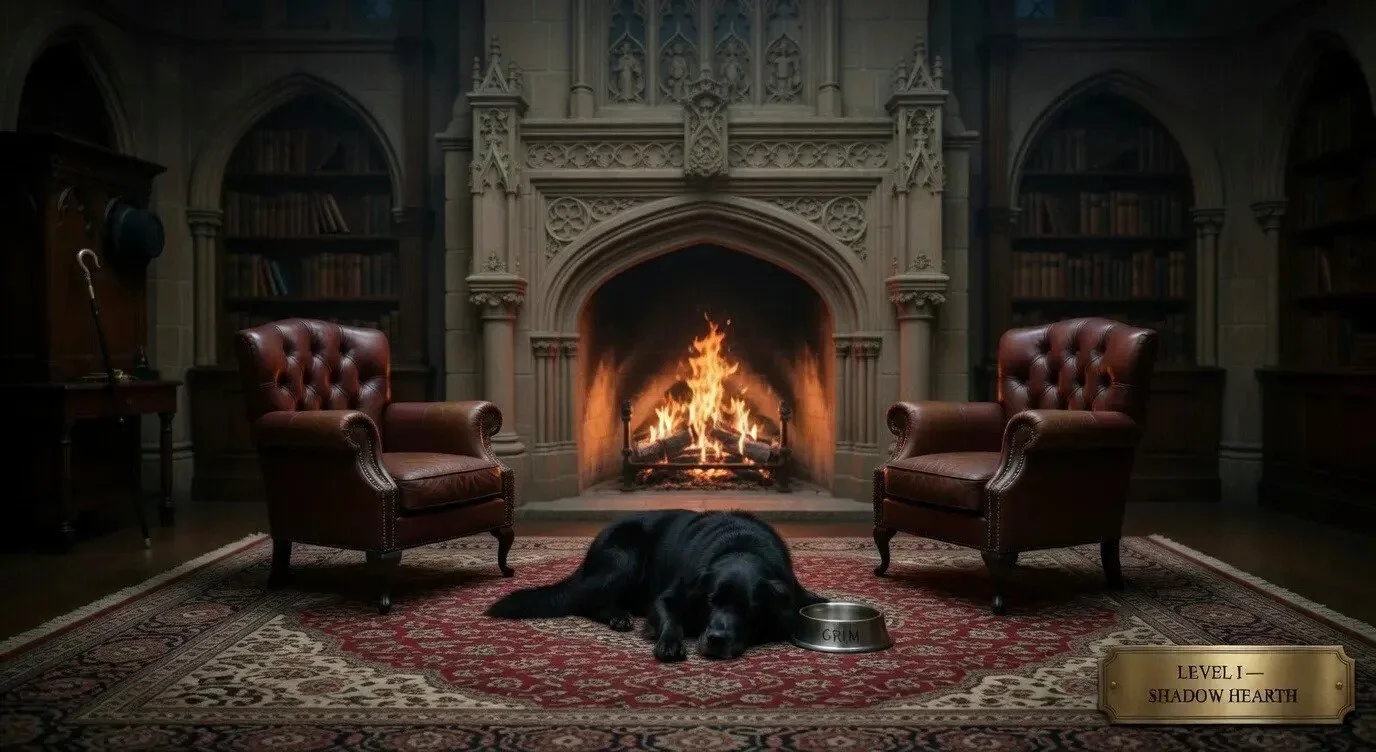
She bumped into the leather couch, prompting Chacha to look up from her usual slumber.
“Oh,” she said, as if she hadn’t noticed where she was. After a second she looked up and said, “Greetings, Readers! Welcome to the Vault! We are so happy to have you visiting us, isn’t that right, Master S?”
From the second floor came a grunt. That sound was common at the Vault, as it was one of the main answers Master S, curator of the Vault, had to offer.
Dr. M was a young woman dressed in a pale blush blouse with a high collar and fitted sleeves, tucked into a dove-grey skirt that reached the floor — the sort of outfit that had started the morning looking perfectly presentable. Her curly hazel hair was tied up at the nape of her neck, not very carefully.
“I’m Dr. M and I am delighted to have you here. Don’t pay attention to Master S — he is usually grumpy.” Another grunt came from the same place as before.
“And how is this silly, silly dog doing today? Moved much?” she asked, knowing full well that Chacha doesn’t move at all.
“By the way, readers — this is Chacha, or as some of you may know her: THE OMEN OF DEATH… ”ooooh” Honestly, I have never seen her omen anything, but that’s what the tag said when she got here.
Her official status in the Vault is Active Stasis in Harmonic Hearth — a classification that Master S arrived at after three weeks of attempting to determine the precise subspecies of folkloric manifestation.
She arrived without a retrieval file and without any prior correspondence with the Communications Bureau. This is not entirely unusual — the Vault receives a number of its best items this way — but it does mean that her provenance remains, technically, unresolved. Master S finds this professionally irritating. I find it amusing, precisely because of that.
She does occasionally raise her head when someone enters. But mostly, she sleeps.
We did our due diligence, and what we found is this: The Grim — the enormous black dog of British and Northern European folklore, glowing-eyed, silent, appearing at roadsides, churchyards, and crossroads without invitation — is one of the oldest death omens in the historical record. Old enough, and present in enough regional variations, to suggest that whatever gave rise to it arose independently in too many places to trace back to a single source.
The name itself is instructive. Grim comes from the Old Norse Grimr — one of the many names of Odin, the Norse god whose portfolio included death, wisdom, wandering, and a fondness for sending large black dogs ahead of him as scouts. These were creatures sent to mark those whose time had come, arriving before the god himself as a kind of advance notice. When Viking settlement brought Norse tradition into sustained contact with British folklore over several centuries, the two lineages merged into the figure that would haunt English rural legend for the next thousand years: a spectral black dog, enormous, silent, and understood — when seen — as a sign that something was already in motion that you would not be stopping.
On the other hand, historical records and folklore songs tell a rather different story. In Scandinavian and Northern English tradition, when a new churchyard was consecrated, the first creature buried in it was believed to become its eternal guardian — bound to protect the graves from robbers, witches, and whatever else might come in darkness to disturb the dead. To avoid requiring a human for this purpose, a black dog was often buried alive at the north entrance of new churchyards. This creature became the Church Grim: a large, black, spectral dog, seen near the church at night not as an omen of death at all, but as evidence that the guardian was on duty.
The same creature with two completely opposite meanings. Which one applied depended entirely on which village you grew up in, and nobody involved thought this was a contradiction. I, for one, find it fascinating. When I told both stories to Chacha, she didn’t seem very interested, to be honest.
Master S says we should probably return her, and who knows what havoc she might cause one day when no one is watching. But come closer, because I can’t say this very loud — I know that when Master S leaves late at night after working long hours and walks to the exit, he stops and scratches Chacha behind the ears. If you ever say I told you this, I will deny it until I turn purple.
Right then.
In any case, she is one of our many residents here at the Vault, and she has her special place on the rug by the fireplace. Feel free to say hello if you ever meet her… or perhaps run the other way. Either seems reasonable.
“Before we go — is there anything you’d like to say to our readers, Master S?”
Another grunt. Dr. M rolled her eyes.
“Ah — there are my bifocals. On the fireplace mantle.” She picked them up, squinting at them with mild suspicion. From somewhere in the upper levels came the low, rolling croak of a raven. Dr. M said nothing, but she did look up.
It was a pleasure meeting you, dear Reader. Until next time — and don’t forget: what is hidden is not invisible.
Item VC-003 remains in Active Stasis in Harmonic Hearth, Level I. The food bowl is to the left of the rug. Master S has noted his objection in the official record. The bowl is always full.
— Dr. M, writing from the Shadow Hearth, 105 Palimpsest Road